

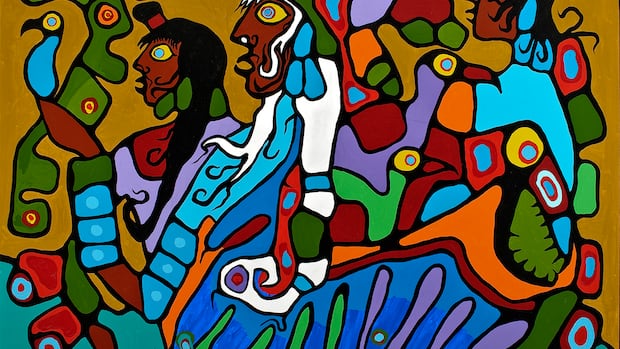


Dubbed the “Picasso of the North” by French modernist Marc Chagall, the Ojibway artist was plagued by a slew of fakes fit to match his Spanish namesake. Some experts put the number of fake Morrisseaus at as many as 10,000, making him one of the most counterfeited artists in the world. It’s a big problem, but Drew Hayden Taylor’s new play makes it personal.
The Undeniable Accusations of Red Cadmium Light, which opens at the Firehall Arts Centre in Vancouver on April 22, follows Nazhi, the curator of an art gallery on the Otter Lake First Nation in central Ontario. Nazhi specializes in Morrisseau’s work, and when a type of paint called Red Cadmium Light is found on one of the artist’s pieces dated years before the pigment was invented, she’s plunged headfirst into a thorny rabbit hole that threatens to engulf her career and her relationship with her daughter.
Taylor, an award-winning Ojibway author, playwright and journalist from Curve Lake First Nation, says the play is “essentially about what is real and what isn’t.”
The idea — to write about Morrisseau and the people that pretend to be him — came to Taylor at a book launch where he met an expert in authenticating Morrisseau’s work. After the two got to talking, he found himself intrigued by “the larger implications of somebody who makes a living pretending to be Norval.”
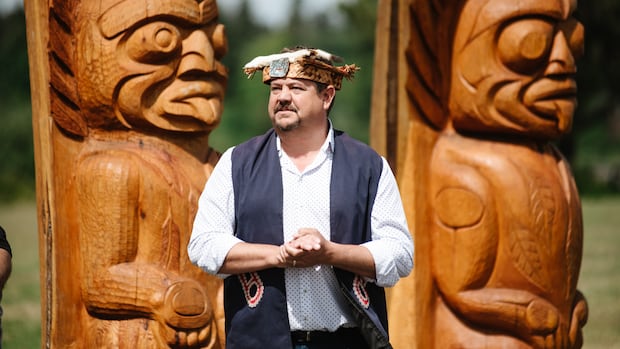
 Drew Hayden Taylor, writer of The Undeniable Accusations of Red Cadmium Light. (Paul Chato)
Columpa Bobb — Tsleil Waututh and Nlaka'pamux actor, playwright and director of the Firehall’s production of Red Cadmium Light — says the play opens “a much bigger bag of issues” than simple forgery. In Canada, the faking of Indigenous art is a massive industry, but Bobb says it’s only one thread in a knot of duplicity and legislated authenticity that deprives Indigenous communities of the right to self-determination. It feels “almost impossible to unravel,” she says. It’s a good thing, then, that Red Cadmium Light isn’t trying to.
“Normally my process in writing a play is the first act asks questions; the second act answers them,” says Taylor. “But, in this case, the first act asks questions and the second act asks different questions.” The industry intrigue of the fake painting at the play’s outset works as a “springboard for larger, more personal issues” that haunt the audience just as much as the characters.
It’s that personal touch, Bobb says, that makes Taylor’s exploration of such a fraught topic feel fresh.
 Columpa Bobb (Facebook )
As an Indigenous artist herself, she was aware of people exploiting Morrisseau even before the forgeries made the news. She remembers watching him paint outside the Vancouver Aboriginal Friendship Centre (then called the Vancouver Indian Centre) when she was a child in the late 1970s and early ‘80s.
“He was painting there partially so that people who worked there could keep an eye out for him,” she says, “because people were trying to take advantage of him … Our folks have known about this kind of thing for a while.” Even so, Bobb always thought of the forgery industry more as a political topic than an interpersonal one.
When she read the script for Red Cadmium Light, she was surprised she never thought of something similar herself, but felt its personal care was completely in keeping with Taylor’s style. “Drew’s got a big heart,” she says, “so of course he’s going to be thinking of the hearts of others.”
Bobb and Taylor have been friends and collaborators for years. The last play Bobb directed at the Firehall — 2017’s Only Drunks and Children Tell the Truth — was also written by Taylor, who considers the venue his west coast home. He’s looking forward to seeing what Bobb and another longtime collaborator, the Firehall’s artistic producer, Donna Spencer, will make of the script.
For her part, Bobb is excited to dive into the “very deep, dark pool” that is the issue of pretendians in the art world, and she’s looking forward to paying tribute to Morrisseau’s work.
 Previously, Androgyny, a huge, colourful painting from famed Anishnaabe artist Norval Morriseau hung in a featured space at Rideau Hall. (Sandra Abma/CBC)
Bobb is Coast Salish and grew up on the west coast. Though she always appreciated Morrisseau’s emotional treatment of colours, it was only when she moved to Ontario that she felt the paintings touch her heart. “As soon as I saw an eastern fall, I got it … The starkness of the climate in the winter and the drama of the stillness — it’s quite remarkable, but it’s very unlike here [in BC].”
Translating that starkness and drama to the stage is front-of-mind for Bobb. It’s a deceptively difficult question — how do you represent forgery in a visual medium without platforming it? Bobb didn’t want to see “a stage peopled with replicas of Indigenous artwork,” so she and the team are “playing a lot with shape and light” to try and evoke the pieces in question without displaying them outright.
Bobb says the production design by Charles Beaver, augmented with lighting by Rebekah Johnson, are more conceptual than strictly literal. She wants the play to create “layers of different kinds of tension, where the elasticity of tension waxes and wanes.”
Euro-Western tropes of set-up and payoff are useful at times, she says, but she doesn’t want to let the audience off the hook that easily.
“My pappy Dan George used to say, ‘You need to allow yourself to embrace the beautiful struggles that are life itself, and fall in love with beautiful oppositions,” she says, referring to her great-grandfather, who was chief of the Tsleil-Waututh Nation, for 30 years in the late 20th century. It’s true that the struggles Red Cadmium Light tackles are painful — exploitation, identity theft and duplicity all sanctioned by the settler state — but Taylor and Bobb do their best to make them beautiful.
The Undeniable Accusations of Red Cadmium Light runs from April 18 - May 3 at The Firehall Arts Centre (280 E. Cordova St.) in Vancouver.