








The shift toward expansive tile surfaces has reshaped modern interiors in unmistakable ways. Clean, uninterrupted lines of porcelain or stone-look material stretch across floors and wrap around walls, replacing the busy grid patterns that defined earlier design eras. The visual simplicity appeals to homeowners who want spaces that feel open and refined. What lies beneath that polished appearance, though, is a set of installation challenges that differ fundamentally from anything smaller tiles present.
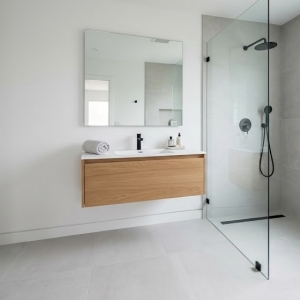
The gap between a successful large-scale tile installation and a failed one usually comes down to preparation, product selection, and technique. Each of those areas operates under rules that simply do not apply when working with conventional dimensions.
How the Industry Classifies These Pieces
The threshold is straightforward: any tile whose longest edge exceeds fifteen inches falls into the oversized category. Standard examples include slabs measuring 24 by 48 inches or 36 by 36 inches, with the most dramatic options reaching dimensions of five feet by ten feet as a single uninterrupted piece.
The aesthetic contribution of these generous proportions is obvious. But size brings material consequences that demand attention. Greater mass increases adhesive load requirements. Increased rigidity means the tile absorbs none of the imperfections sitting beneath it on the substrate.
Subfloor Preparation: Where Most Jobs Succeed or Fail
Ask any experienced flooring professional what determines the longevity of an installation, and the answer invariably starts with the substrate. Small ceramic tiles are tolerant of minor surface inconsistencies. Their size lets them flex slightly, and their frequent grout joints mask small deviations. None of that tolerance exists with oversized pieces. A rigid slab spanning a dip in the subfloor creates an unsupported zone at its center. Apply weight there, and the material fractures.
Flatness—not levelness—is the critical measurement. A floor can intentionally slope for drainage and still be perfectly acceptable for tile. What it cannot be is uneven. Industry standards require flatness within one-eighth inch across every ten-foot span for this category of work. Meeting that tolerance typically involves pouring a self-leveling underlayment or applying floor patch compound before any tile is placed.
Wood substructures heighten the demands further. Joists must be inspected for structural integrity, and plywood must be firmly fastened with zero movement. Any bounce or deflection in the wood transmits directly through a rigid slab, producing edge cracks that may appear weeks after the project is completed.
Before committing to materials, it is worth visiting a ceramic tile shop to discuss your specific substrate conditions with their technical team. They routinely advise on prep requirements for different subfloor types and can recommend the appropriate leveling or patching products for your situation. That conversation, conducted before the slabs are ordered, prevents expensive course corrections later.
The Lippage Challenge at Scale
Lippage is the technical term for height discrepancy between the edges of two adjacent tiles. A fraction of a millimeter is invisible on small ceramic pieces. On a large slab with rectified edges, that same deviation creates a pronounced ridge visible from across the room and tangible under bare feet.
Rectified tiles receive precision cutting after firing, producing perfectly square corners with no cushioned bevel. Standard tiles include that bevel specifically to disguise minor height variations. Without it, two rectified edges meeting at a tight joint expose every inconsistency in the mortar bed beneath them.
Professional installers counter this through mechanical leveling clip systems. Interlocking plastic wedges and caps lock adjacent tiles into a shared horizontal plane while adhesive cures. This hardware is considered standard-issue among crews who regularly work with large format tiles. Attempting flush alignment by hand and eye alone produces results that are visibly uneven.
Mortar Formulation and Trowel Technique
Standard thin-set mortar is not engineered for oversized materials. Its sag resistance and bond strength fall short when supporting heavier pieces across broader coverage areas. Mortars designed specifically for large-format work deliver the non-sag consistency and extended open time necessary for accurate positioning of substantial slabs.
Trowel selection must be scaled up proportionally. Where a small tile installation might call for a quarter-inch notch, these pieces demand half-inch or three-quarter-inch teeth. The deeper grooves deposit a thicker adhesive bed that fills surface micro-texture and compensates for minor substrate deviations.
Back-buttering transitions from a recommended technique to a mandatory step. Spreading mortar onto the back of each slab before setting it into the floor bed forces out trapped air and pushes coverage toward the one hundred percent mark. Any remaining void becomes a load-bearing weakness. When weight concentrates over an unsupported zone, the tile breaks along that exact point.
Handling, Cutting, and Climate Control
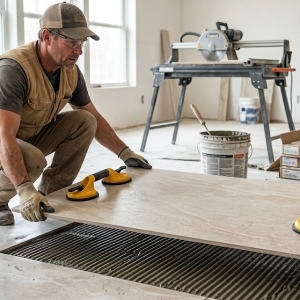
Individual oversized porcelain pieces can weigh more than one hundred pounds. Attempting to carry them without proper equipment risks both personal injury and catastrophic material damage. Industrial suction cups provide reliable grip on smooth tile faces, and reinforced carrying frames allow two people to transport slabs without bending or stressing them.
Cutting equipment must correspond to the material's density and dimensions. Standard snap cutters cannot accommodate dense oversized slabs. A wet saw with a sliding table provides the capacity for clean, straight cuts along the full length. Specialized scoring tools offer an alternative for long straight cuts, reducing the risk of edge chipping.
Environmental factors during the installation period deserve attention that many crews overlook. Elevated temperatures, dry air, or drafts accelerate mortar skinning—a condition known as flash curing. The adhesive surface hardens before the tile can be properly positioned, compromising the bond permanently. Maintaining stable room temperature and limiting airflow throughout the work area prevents this outcome.
Grout Selection and Long-Term Movement
The assumption that larger tiles eliminate grout is inaccurate. Even the narrowest joints between rectified edges—down to one-sixteenth inch—require a filler material. Traditional sanded grout resists compression into such slim spaces and introduces abrasive particles that scratch polished tile surfaces.
Urethane-based and epoxy grouts are better suited to these tight joint conditions. They maintain flexibility over time, resist staining, and do not require periodic sealing. Selecting the right product for your specific joint width and tile finish is a detail worth getting right during the planning stage rather than discovering a problem after installation.
Movement joints are equally essential to long-term performance. All tile responds to temperature and humidity fluctuations with expansion and contraction. Covering a broad floor with rigid oversized material amplifies the cumulative force of that movement. Without perimeter gaps concealed behind baseboards and strategic soft joints at room transitions, internal stress builds until tiles crack or lift from the substrate. These deliberate interruptions allow the floor to move as a coordinated unit.
Why Your Supplier Choice Matters
The technical complexity of these installations makes your materials source a genuine project resource rather than a simple retail point of contact. A ceramic tile shop staffed with knowledgeable professionals stocks the complete ecosystem of products these installations require—slabs, specialized mortars, appropriate trowels, leveling hardware, and surface preparation materials.
Arriving at the shop with floor measurements, subfloor specifications, and photographs of the existing conditions transforms your visit into a productive planning consultation. The staff can compile a targeted materials list that accounts for every variable in your specific project, minimizing the risk of discovering a missing product once work has commenced.
Closing Reflections
Undertaking an oversized tile installation demands patience, precision, appropriate tools, and genuine understanding of material behavior. The slabs represent a significant financial investment, and mistakes at this scale carry proportional consequences. Yet when each phase of the process receives the attention it requires, the finished result is a surface of striking simplicity and lasting quality.