



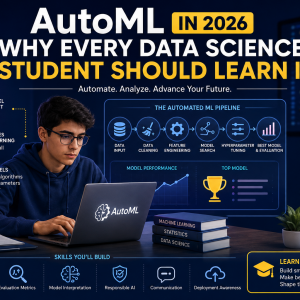





Landing a data science or machine learning job is becoming more competitive every year. Employers are no longer impressed by basic prediction models or classroom assignments alone. They want graduates who understand how artificial intelligence works in real business environments.
That means learning more than algorithms. Students who want to stand out in 2026 should focus on building production-ready AI skills, combining machine learning knowledge with cloud computing and MLOps.
Move Beyond Notebook Projects
Most university assignments end when the model achieves good accuracy. In the workplace, that is only the beginning.
A machine learning model must be deployed so users can access it, monitored to ensure it performs correctly, and updated as new data becomes available. This entire process is what businesses expect modern AI professionals to understand.
Learning how to move projects from a Jupyter Notebook into a cloud environment can dramatically improve your employability.
Why Cloud Platforms Matter
Companies rely on cloud services because they offer flexibility, scalability, and lower infrastructure costs. Instead of managing physical servers, businesses use platforms like AWS and Microsoft Azure to run applications and machine learning models.
For students, gaining experience with one cloud platform provides a significant advantage during recruitment. Even a small deployment project demonstrates that you understand how AI applications operate outside a classroom environment.
Cloud knowledge also complements programming skills, making candidates more valuable for roles in data science, machine learning engineering, and AI development.
Learn the MLOps Workflow
MLOps connects data science with software engineering. Rather than treating machine learning as a one-time task, it creates a repeatable process for building, deploying, testing, and improving AI systems.
A typical workflow includes version control using Git, containerization with Docker, deployment through cloud services, and monitoring application performance after launch.
These skills allow teams to update models efficiently while reducing downtime and improving reliability.
Understanding this workflow prepares students for the responsibilities they will face in professional AI teams.
Create Projects Employers Want to See
Recruiters often spend only a few minutes reviewing portfolios. Well-documented projects immediately attract attention because they show practical experience.
Instead of building several unfinished experiments, create one complete project from start to finish.
For example, develop a customer review classifier using Python, package it with Docker, deploy it on AWS or Azure, and publish the source code on GitHub. Add screenshots, explain the deployment process, and describe the challenges you solved.
A project like this demonstrates technical ability, problem-solving skills, and professional thinking far better than a collection of isolated notebooks.
Avoid Common Learning Mistakes
Many students try to learn every new technology at once. They watch endless tutorials but never complete a working application.
A better strategy is to focus on fundamentals.
Master Python first. Learn Git for collaboration. Understand Docker before exploring Kubernetes. After deploying a few projects, expand into automation and monitoring.
This structured approach creates confidence while helping you retain what you learn.
If cloud computing assignments or MLOps projects become difficult, seeking guidance is a smart decision. Educational platforms like Expertsmind.com connect students with experienced tutors who can explain cloud deployment, Docker, machine learning workflows, and related technical concepts, helping learners build stronger practical skills alongside their academic studies.
Prepare for Tomorrow's AI Careers Today
The demand for AI professionals continues to grow, but employer expectations are changing just as quickly.
Graduates who understand machine learning alone may struggle to compete against candidates with cloud deployment and MLOps experience. By investing time in practical projects, learning cloud platforms, and understanding production workflows, students can build a portfolio that reflects the needs of today's hiring market.
The future belongs to professionals who can not only create intelligent models but also deliver reliable AI solutions that businesses can use every day. Developing those skills before graduation is one of the smartest career investments any aspiring data scientist can make.