



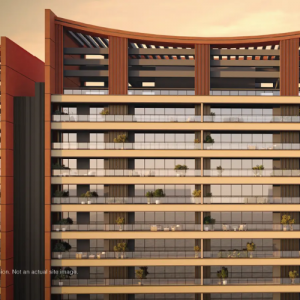


The global facade market is projected to witness strong expansion over the next decade, supported by accelerating infrastructure investment and rising commercial, residential, and industrial construction across major global economies. The market is expected to grow steadily, reaching approximately USD 660.83 billion by 2036, registering a CAGR of 5.6%, according to the latest analysis by Future Market Insights (FMI).
Market growth is being shaped by expanding end-use applications, growing adoption across key verticals, and regulatory compliance requirements. Facades have evolved from standard building enclosures into highly engineered, performance-driven architectural systems essential for building efficiency and regulatory adherence. While traditional installations continue to hold ground, modern developments are increasingly incorporating advanced solutions like ventilated systems and sustainable material options to meet modern environmental expectations and improve overall operational performance.
Global Facade Market Snapshot (2026–2036)
- Market size outlook toward 2036: USD 660.83 billion
- Forecast CAGR (2026–2036): 5.6%
- Incremental opportunity value: USD 277.61 billion
- Dominant product type segment: Curtain walls (28.6% share in 2026)
- Dominant system type segment: Ventilated facades (61.9% share in 2026)
- Leading material segment: Glass (34.2% share in 2026)
- Key growth countries: China (7.6% CAGR), India (7.0% CAGR), Germany (6.4% CAGR)
Momentum in the Market
Beginning from steady baseline valuation levels of USD 362.90 billion in 2025, the global facade market demonstrates accelerated growth throughout the forecast period as structural procurement patterns modernize worldwide. By the end of 2026, the market is set to reach USD 383.20 billion, driven heavily by immediate infrastructure needs and commercial building completions.
Between 2026 and 2036, expanding industrialization, urbanization, and the modernization of existing building envelopes are expected to significantly boost demand for specialized facade systems. Favorable total cost of ownership calculations and growing familiarity among corporate and municipal procurement decision-makers are shifting long-term investment toward high-performance building skins. From 2036 onward, the convergence of stricter carbon-reduction laws and automated building technologies is expected to further strengthen market volume, pushing the industry deeper into a highly technical engineering paradigm.
The Reasons Behind the Market’s Growth
Demand for facade products worldwide is rising due to multiple structural, geographical, and institutional factors reshaping the construction and industrial ecosystems.
Expanding End-Use Applications Rapidly evolving building specifications and greater adoption across primary verticals like commercial real estate and public institutional sectors are providing strong foundational support to the market.
Regulatory and Compliance Requirements Governments and regulatory bodies are enforcing stricter building safety, structural stability, and efficiency criteria. This creates structured procurement cycles as organizations systematically upgrade to facade setups that meet updated standards.
Geographic Expansion into High-Growth Markets Aggressive economic development, macro-level infrastructure pipelines, and large-scale urban development programs in developing nations are providing significant avenues for high-volume consumption.
Demonstrated Operational Efficiency Procurement managers are increasingly prioritizing building skins that offer proven long-term performance benefits, stabilizing maintenance costs and generating better resource insulation profiles over time.
Top Segment Application Type
Curtain Walls and Ventilated Systems Dominate Market Demand Curtain walls continue to account for a significant portion of the product type arena, capturing a 28.6% market share in 2026. This performance is sustained by deep-rooted procurement networks and wide compatibility across standard layout frameworks.
Segment Structural Analysis
- Ventilated Type: Captures 61.9% of the type category in 2026, marking it as the most widely integrated configuration across premium deployment designs.
- Glass Material: Holds 34.2% of the material segment focus, driven by high design concentration among primary corporate office and multi-use developer projects.
- Alternative Products: Lightweight facades, panel layouts, prefabricated units, and traditional stonework serve additional niche application contexts.
Regional Development: Emerging Infrastructure Pipelines Drive Expansion
The global landscape highlights a clear divide between high-volume production centers and mature institutional upgrade regions.
- China: The undisputed country-level growth leader with a 7.6% CAGR through 2036, backed by colossal manufacturing networks, new economic zones, and heavy national infrastructure funding.
- India: Expanding rapidly at a 7.0% CAGR, driven by vast urban modernization projects, tech-park developments, and industrial corridors.
- Europe: Represents the largest overall regional block by demand, where major economies like Germany (6.4% CAGR) and France (5.9% CAGR) focus extensively on regulatory-driven retrofits and operational upgrades.
Challenges, Trends, Opportunities, and Drivers
Drivers
- Large-scale international infrastructure investments
- Stringent environmental and structural safety regulations
- Growing preference for performance-validated building materials
- Rapid urbanization in major developing economies
Opportunities
- Specialized geographic expansions into emerging secondary cities
- High-performance ventilated facade deployment
- Pre-engineered and prefabricated structural building sections
- Long-term institutional and public procurement partnership agreements
Trends
- Transition from purely cosmetic architecture to highly specialized industrial insulation supply
- Increasing use of structural glass and integrated lightweight framing systems
- Procurement consolidation among primary Tier-1 contractors
- Shifting emphasis toward total cost of ownership and verified longevity
Challenges
- Intense price sensitivity among regional cost-driven buyer brackets
- Margin compression stemming from institutional procurement consolidation
- Competition from lower-grade alternative building shell installations
The Competitive Environment
The global facade market operates in a moderately consolidated layout where major multinational manufacturers compete primarily through product performance, supply scale, and long-term delivery reliability.
A clear example of this market concentration is Saint-Gobain, which maintains a leading position with an estimated 13.0% global market share. Market leaders protect their positions through volume-based pricing structures, established long-term material supply contracts, and close collaboration with premier institutional buyers. Differentiation is increasingly shifting away from basic fabrications toward certified technical reliability, total life-cycle savings, and localized logistics support.
Future Outlook: Toward Performance-Driven Building Shells
The global facade market is moving through a transformative decade defined by technical industrialization, shifting procurement rules, and high efficiency expectations. Future facade frameworks will operate less like static walls and more like complex structural interfaces built to optimize safety, insulation, and durability. As developers and public sectors seek highly durable engineering layouts, facade systems will remain central to the long-term master planning of global smart cities and industrial developments.
Report Link: https://www.futuremarketinsights.com/reports/facade-market