


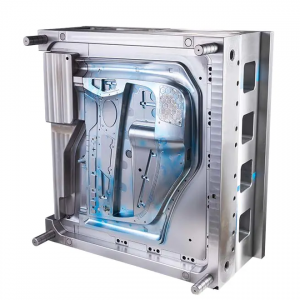








The efficiency and quality of injection molding production depend heavily on process parameters controlled during operation of the Injection Mold system. These parameters must be carefully balanced to ensure stable and defect-free production.
Injection pressure is one of the most important parameters, typically ranging from 70 MPa to 200 MPa depending on material viscosity and part geometry. Insufficient pressure can lead to incomplete filling, while excessive pressure may cause flash or mold damage.
Melt temperature is another critical factor. Most thermoplastics are processed between 180°C and 300°C. Higher temperatures improve flowability but may degrade material properties if not controlled properly.
Holding pressure and time help compensate for material shrinkage during cooling. This stage ensures dimensional stability and reduces internal voids. Holding time is usually a fraction of total cycle time but has a significant impact on final quality.
Cooling time is the longest part of the cycle, often accounting for more than half of the total production time. Efficient cooling design within the Injection Mold can significantly improve productivity.
Injection speed also plays a key role. Faster injection speeds help fill complex geometries but may introduce turbulence or air traps if not optimized.
Modern manufacturing systems increasingly use data-driven optimization and simulation tools to fine-tune these parameters. By analyzing pressure curves, temperature distribution, and flow behavior, engineers can reduce defects and improve consistency.
Ultimately, optimizing Injection Mold process parameters is essential for achieving high productivity, low scrap rates, and consistent product quality in mass production environments.