



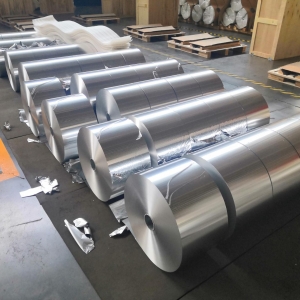




80-micron Anodized Aluminum Foil Strip is a coil-form product engineered for applications that require a thin, dimensionally consistent aluminum substrate with a hard, corrosion-resistant oxide surface. The manufacturing route typically includes rolling to target gauge, cleaning and surface preparation, anodizing in a controlled electrolyte, optional coloring (dyeing or electrolytic coloring), and sealing to improve pore closure and long-term corrosion behavior. Because anodizing converts the aluminum surface into an oxide layer, the finish is integral to the substrate and can provide durable performance compared with many organic coatings.
The anodized surface changes the strip’s functional properties in predictable ways. It increases surface hardness and wear resistance, improves resistance to atmospheric corrosion, and can provide electrical insulation at the surface—useful for certain electronic and thermal-management assemblies. However, the same hardness that improves durability also imposes forming limits. For stamped or bent parts, process design typically emphasizes moderate deformation, generous bend radii, and well-polished tools to minimize micro-cracking and maintain cosmetic consistency. Where aggressive forming is unavoidable, designers may specify anodizing after forming, or choose anodic thickness and sealing conditions that reduce brittleness while still meeting corrosion targets.
Converting performance depends heavily on coil quality and surface cleanliness. At 80 µm, the strip is sensitive to tension variation, edge damage, and roll marks; therefore, slitting accuracy, burr control, and packaging protection are important to prevent defects that could compromise both appearance and functional performance. For adhesive bonding or printing, anodized surfaces may require specific primers or surface energy control, and sealed anodic layers can influence adhesion; process trials are commonly used to match adhesives and inks to the anodized finish.
Quality assurance programs typically verify base metal gauge, mechanical properties by temper, and surface characteristics including anodic thickness, uniformity, color consistency, gloss, and sealing quality. Additional testing may include salt spray or cyclic corrosion tests, abrasion resistance evaluation, and dielectric breakdown testing where insulation performance is required. In applications such as decorative trims, electronics insulation strips, and precision industrial components, these controls ensure that 80-micron anodized aluminum foil strip delivers consistent coil-to-coil performance, predictable converting behavior, and long service life in demanding environments.